
Tokyo is where most Australian travellers start a first Japan trip. Give it five to seven days if you can: enough for neighbourhoods, a dawn temple visit and one day trip, without treating the city as a checklist. A Suica card covers almost everything in town. A nationwide rail pass only matters once you leave for the west.
Is Tokyo the right first stop?
Tokyo is where ancient ritual meets a city that moves at full speed. Best months are usually March to May and September to November. Our editorial daily starting point is from approx. approx. A$74 (about 8,000 yen) for a tight budget, excluding flights.
It suits first-time visitors, food lovers, solo travellers and anyone who wants neighbourhood variety in one place. Think twice if you came only for quiet temples (Kyoto does that better), if you cannot manage summer humidity, or if you hoped a short weekend from Australia would be enough. It will not be.
What does Tokyo actually cost?
These totals are Tripnook editorial estimates per person for accommodation, food, local transport and typical activities, excluding international flights. They are approximate figures, not a quote.
| Style | 3 days | 5 days | 7 days | 10 days |
|---|---|---|---|---|
| Budget | 30,000 yen (from approx. approx. A$276) | 50,000 yen (from approx. approx. A$461) | 70,000 yen (from approx. approx. A$645) | 100,000 yen (from approx. approx. A$921) |
| Comfort | 60,000 yen (from approx. approx. A$553) | 100,000 yen (from approx. approx. A$921) | 140,000 yen (from approx. approx. A$1,290) | 200,000 yen (from approx. approx. A$1,842) |
| Premium | 120,000 yen (from approx. approx. A$1,105) | 200,000 yen (from approx. approx. A$1,842) | 280,000 yen (from approx. approx. A$2,579) | 400,000 yen (from approx. approx. A$3,685) |
What should I book first?
- Flights: book early. Tokyo stays busy and good fares often tighten by about eight weeks out.
- Hotels: book early. Shinjuku or Ueno are practical first bases because of the rail connections.
- Experiences: reserve tea ceremonies, sushi counters and popular exhibitions two to three weeks ahead.
- Rail pass: usually optional if you are staying in Tokyo. Buy a pass only if you will also ride the Shinkansen west.
- Car hire: skip it in the city. Parking is scarce and the trains are faster.
A Japan eSIM or other data plan on landing is more useful than a pocket-Wi-Fi queue. We do not have an affiliate eSIM or insurance partner, so we do not name one here. Medical care in Japan is excellent and can be expensive for visitors; take out cover that includes medical and luggage.
When should I go, and what should I do?
Spring and autumn are the most comfortable. Cherry blossom is usually late March to early April and should be booked months ahead. Summer is manageable only if you sightsee early and late. Winter is quieter and often clearer.
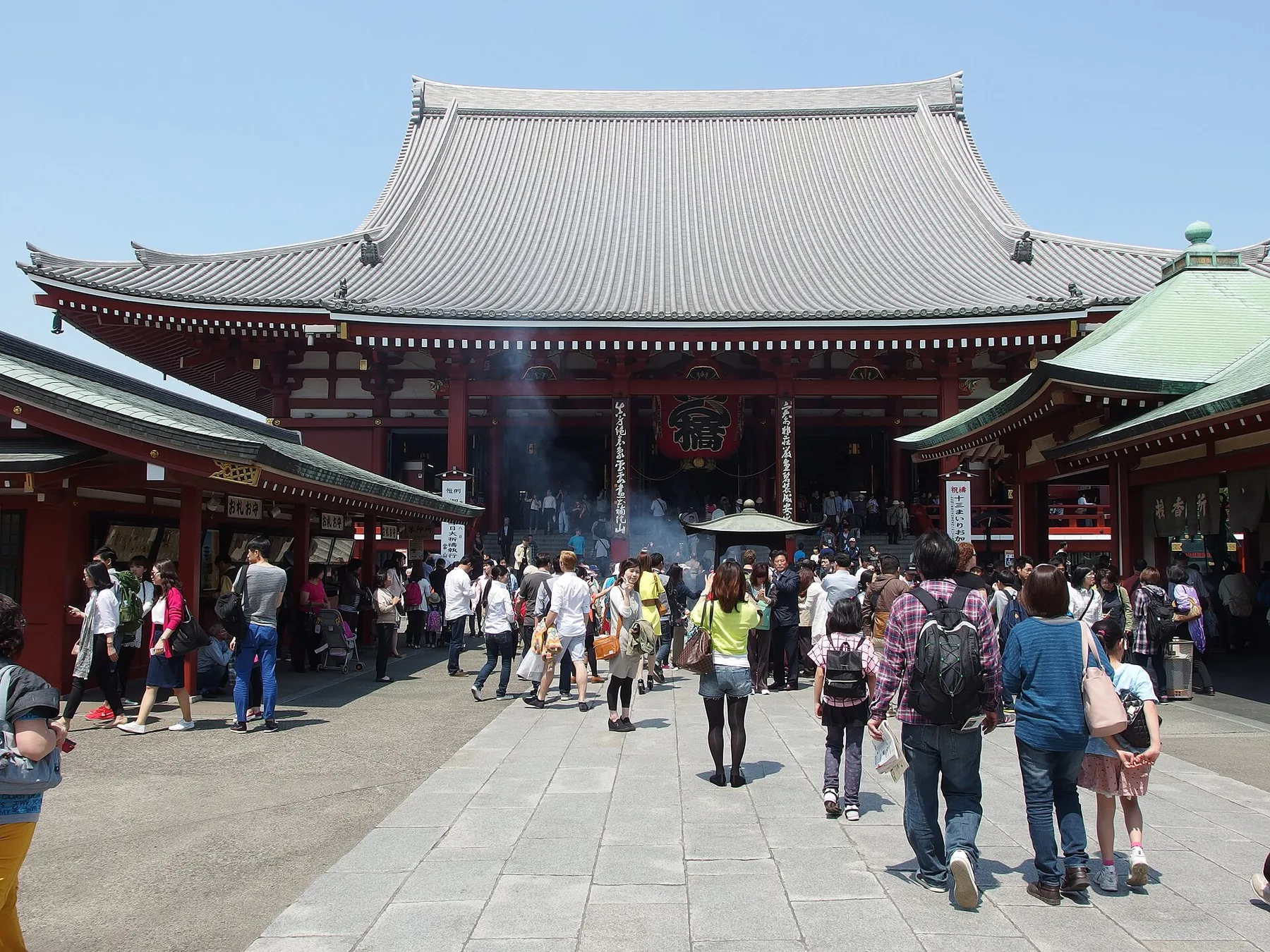
Start one morning at Senso-ji in Asakusa before the tour groups fill the courtyard. Walk Meiji Jingu for a forest pause. Use Shibuya or Shinjuku for energy, not as your only impression of the city. Yanaka is calmer if you want an older neighbourhood. TeamLab-style digital exhibitions are popular and sell out; check official pages for the current show and tickets rather than treating a name as a permanent fixture.

Where should I stay?
Shinjuku is convenient and busy. Shibuya is fashion and the crossing, and it does not really rest. Asakusa is slower and close to Senso-ji. Shimokitazawa and Yanaka are quieter and better if you like walking. Ginza is the formal, expensive end of town. We have dropped neighbourhood scores; pick the atmosphere, not a number.
Where should I go next?
From Tokyo, a natural next step is an overnight in Hakone for onsen towns and lake country, or Mount Fuji around Kawaguchiko if the forecast is clear. Then take the Shinkansen west to Kyoto. The full journey is:
Visiting in spring? Our 2027 cherry blossom guide has average bloom dates for Tokyo. For a full route that starts here, see our 7, 10 and 14-day Japan itineraries.
Is there a useful official video for this place?
How do I get there from Australia or elsewhere?
The official airline and airport notes, including Qantas, ANA and JAL’s current winter timetable, are in the First-Time Japan guide and in the sourced table on this page where they apply. Flying times are not quoted here; check the airline site for current durations when you book.
For Tokyo itself, Haneda (HND) is usually closer to the central wards than Narita (NRT). Both appear as official arrival airports on the airline pages in First-Time Japan. Choose the airport that matches your ticket. If you have to change between Haneda and Narita, official Qantas partner advice is to allow at least four to five hours, because the airports are about 80 km apart.
How do I get around once I arrive?
A stored-value IC card is the simplest way to ride trains and buses, and to pay at many convenience stores. Official Welcome Suica and visitor ICOCA prices are in the First-Time Japan guide and, where they apply, in the sourced table on this page. Yen figures below were last checked 14 November 2026; Australian dollar conversions are approx.
For a heavy subway day, Tokyo Metro sells a Tokyo Subway Ticket that covers all Tokyo Metro and Toei Subway lines for 24, 48 or 72 hours from the start of use. Official adult prices are 1,000 yen (approx. approx. A$9.21), 1,500 yen (approx. approx. A$13.82) and 2,000 yen (approx. approx. A$18.42); child tickets are half. Source: Tokyo Metro, Tokyo Subway Ticket. A Tokyo Metro-only 24-hour ticket is 700 yen (approx. approx. A$6.45) for adults and 350 yen (approx. approx. A$3.22) for children, and does not include Toei lines. Source: Tokyo Metro, 1-Day Open Tickets. A nationwide Japan Rail Pass is usually optional if you are staying inside Tokyo.
What does a two or three day Tokyo plan look like?
This is a sample outline, not a booking itinerary. Swap days around if the weather or a reserved table says so.
Day 1. Start early at Senso-ji, then cross to a calmer neighbourhood such as Yanaka or the grounds of Meiji Jingu before the afternoon crowds. Keep the first evening close to your hotel so the jet lag does not wipe you out. Day 2. Pick one busy district (Shinjuku or Shibuya) and one slower one, rather than treating the Yamanote line as a checklist. If you want a digital exhibition, check the official ticket page for the current show. Day 3. Either stay in the city for a museum and a neighbourhood walk, or use the day as your first trip toward Hakone or Mount Fuji, if the forecast is clear.
What is Tokyo like to eat?
You can eat very well here without chasing a famous counter. Convenience-store breakfasts, standing soba, a lunch set (teishoku) and a bowl of ramen are the everyday pattern for many visitors on a budget. Reserve a sushi counter or a special meal if you want one, but do not treat it as the only way to eat in the city. We are not making health claims about any dish; this is about what is easy to find and what usually needs a booking.
What etiquette should I actually bother with?
A little goes a long way. Say sumimasen and arigatou, take your shoes off when you see a step or a rack, and keep phone calls off quiet train carriages. At shrines and temples, follow the posted path and do not block the offering box for a photo. Cash is still useful for small places. Tattoos can be an issue in some public baths; ask when you book, or choose a room with a private bath.
In Tokyo the main friction is crowding, not ceremony. Stand to the side on escalators as posted, and do not stop in a station ticket gate to check your phone.
What mistakes do first-time visitors make?
The usual ones are packing the days too tightly, buying a nationwide rail pass without doing the maths, and arriving without a way to pay for a train. Get the IC card or pass sorted on day one. People also underestimate summer heat and leave a mountain night or Hiroshima as a maybe that never happens. Book the rooms that will sell out, and leave some afternoons unplanned.
In Tokyo, the special mistake is trying to see the whole city in two days, then being too tired to enjoy the one neighbourhood you would have liked. Pick fewer stops.
How do I book flights and hotels?
Fly into Tokyo Haneda or Narita. The search below is set to Tokyo (TYO). Search links below open Aviasales with a departure city near you (Sydney if we cannot tell), and Trip.com’s hotel search for your region. These are starting points, not quotes.
Which figures have been checked against official sources?
Yen amounts below are as published on the official pages, last checked 14 November 2026. Australian dollar figures are approx. conversions using the ECB reference rate via Frankfurter on 13 November 2026 (1 AUD = 108.56 JPY). They are estimates, not a ticket price.
| Item | Official figure | Source |
|---|---|---|
| Japan Rail Pass, ordinary adult, official online purchase | 7-day 50,000 yen (approx. approx. A$461); 14-day 80,000 yen (approx. approx. A$737) | JR Group, Japan Rail Pass types and prices |
| Qantas published Australia-Japan routes (no airborne times quoted) | Direct: Tokyo Haneda-Sydney; Tokyo Narita-Brisbane; Tokyo Narita-Melbourne. Seasonal Sapporo-Sydney from 7 December 2026 to 31 March 2027. No direct Japan-Perth service listed on this page. | Qantas, international flight routes |
| ANA published Australia routes, 25 October 2026 to 27 March 2027 | Daily Haneda-Sydney (NH879/889 and NH880/890) and daily Narita-Perth (NH881/882). | ANA, international route information |
| Welcome Suica, official visitor IC card (JR East) | No deposit. Opening balance from 1,000 yen (approx. approx. A$9.21) to 10,000 yen (approx. approx. A$92). Valid 28 days from the date of purchase, including that day. Remaining credit is not refundable. | JR East, Welcome Suica purchase |
| Tokyo Subway Ticket, adult (Metro and Toei) | 24-hour 1,000 yen (approx. approx. A$9.21); 48-hour 1,500 yen (approx. approx. A$13.82); 72-hour 2,000 yen (approx. approx. A$18.42). Child tickets half. Valid from the travel starting time. | Tokyo Metro, Tokyo Subway Ticket |
| Tokyo Metro 24-hour Ticket, Metro lines only | Adult 700 yen (approx. approx. A$6.45); child 350 yen (approx. approx. A$3.22). | Tokyo Metro, 1-Day Open Tickets |
| Haneda-Narita connection allowance, Qantas partner page | About 80 km between the airports; allow at least four to five hours between flights when you have to change airports. | Qantas, Jetstar Japan partner page |
From Narita, the Narita Express (N’EX) to Tokyo Station is 3,140 yen (approx. approx. A$29) one way in an ordinary reserved seat. If you hold a non-Japanese passport, JR East’s N’EX Tokyo Round Trip Ticket is 5,200 yen (approx. approx. A$48) for one ride in and one ride back within 14 days. Source: JR East, N’EX Tokyo Round Trip Ticket. From Haneda, check the Keikyu and Tokyo Monorail sites for current fares.
Frequently asked questions
How many days do you need in Tokyo?
Five to seven days covers the major neighbourhoods and a day trip. Ten days lets you slow down. Three days is possible but rushed.
Is Tokyo safe?
Yes. It is one of the safest large cities you can visit. Solo travellers, including women, generally find it straightforward to move around at night.
How do I get around Tokyo?
The metro and JR lines. Get an IC card such as Suica at the airport and use a maps app for live routes. Taxis are rarely worth the cost.
What is the best neighbourhood to stay in?
Shinjuku for convenience and nightlife, Asakusa for atmosphere, Shibuya for fashion and the crossing, Ginza for a more formal stay. Skip Akihabara unless you came for electronics and games.
Do I need to speak Japanese?
No, but it helps. Tourist areas have English signage. Download an offline translation pack before you fly.
Is Tokyo expensive?
Less than many people expect. Our editorial range is about 10,000 yen a day on a tight budget, and 25,000 to 35,000 yen in the mid range, with rooms as the usual outlier.
Do I need a Japan Rail Pass for Tokyo only?
No. An IC card covers the city. A pass starts to matter when you add Shinkansen travel to Kyoto, Osaka or Hiroshima.
When is cherry blossom season in Tokyo?
Usually late March to early April, and the dates move a little each year. Ueno Park, Chidorigafuchi and Shinjuku Gyoen are popular places to see it.
Is Tokyo good for solo travellers?
Yes. Counter dining is normal for one person, and the city is easy to explore alone.
Can I use credit cards in Tokyo?
Often, but not everywhere. Carry 5,000 to 10,000 yen in cash for smaller restaurants, temples and markets.
Is Tokyo good in summer?
It is hard work. July and August often feel extremely hot and humid. Walk early and late, and use the trains in the middle of the day.
What are the best day trips from Tokyo?
Hakone for onsen and mountain scenery, Kamakura for temples and the Great Buddha, and Nikko if you want a longer shrine day. Kyoto is a Shinkansen trip, not a casual day trip.
What is TeamLab?
A popular digital art exhibition brand with venues that change. Check the official site for what is open, book ahead, and confirm current ticket prices there.
Where do locals eat?
Look past the first lane of a famous crossing. Yakitori alleys, department-store basements and neighbourhood ramen counters are a better first education than a themed restaurant on a main tourist street.
Is a Tokyo Subway Ticket better than tapping an IC card?
It can be, if you will ride Metro and Toei often in a 24, 48 or 72 hour window. The official adult 24-hour Subway Ticket is 1,000 yen. For a light day, a stored-value card may be cheaper. It does not replace JR lines.
Photo credits
- Hero image: Photo: David Kernan, CC BY 4.0, via Wikimedia Commons.
